
POVEN, PRODUCTIVE & PROFESSIONALLY MATURED. BUILT FOR HIVE SUCCESS.
Mated Queen Bees For Sale
Happy Bee express ships strong, productive queen bees from the Northern Rivers to most states in Australia.
Buy premium, mated queen bees that are caught later, fully established, and proven to lay.
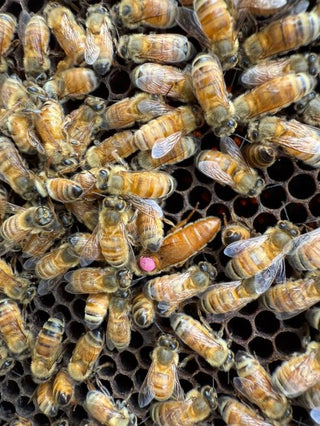
Meet our Beegentics™ Live F1 Mated Queen Bees
Beegentics™ F1 Queen Bees are bred for balance, strength, and reliability in real Australian conditions.
Raised from carefully selected breeder lines in the Northern Rivers of New South Wales, each queen is chosen for the traits beekeepers value most. Calm temperament, resilience, and strong hygienic behaviour form the foundation of this line.
These are first-generation (F1) queens, meaning they inherit robust genetics while still retaining adaptability through open mating with locally adapted drones. The result is a queen that performs consistently across a range of environments, seasons, and management styles.
Our bees are known for:
- Calm temperament
- Strong hygienic behaviour
- Resilient, locally adapted genetics
- Consistent brood pattern
- Reliable productivity

What we do differently
Most mated queens are sold as soon as mating is assumed or shortly after early laying begins. We take a slower, more deliberate approach.
Our queens are:
- Caught at 28 days of age
We hold queens for 14 days longer than industry standard - well beyond initial mating and early laying. This allows them to fully mature, stabilise, and develop stronger pheromone signals before being introduced into a new hive. - Walking on their own capped brood
Each queen has already demonstrated consistent laying. Seeing capped brood confirms that she is fertile, accepted by her original colony, and actively doing the job she was bred for. - Producing pheromones at their peak
Pheromone production increases as queens mature and begin laying. Strong pheromone signals improve colony cohesion, suppress laying workers, and significantly improve acceptance during introduction. - Achieving acceptance rates of up to 90 percent
Research and field experience show that queens introduced at the right stage of maturity have much higher survival and acceptance rates compared to younger queens, particularly when introduced correctly into a queenless hive. - Known, proven layers
These queens are not sold on potential. They are selected after laying performance has been confirmed, reducing the risk of early failure or supersedure.
How to purchase mated queens from Happy Bee
We catch our queens every Sunday and prepare them for shipment on Monday mornings.
They are sent by Australia Post Express Post so they are in transit for the shortest possible time and can be collected promptly from your local post office once they arrive.
Why Express Post Matters
Shipping live bees is logistic work. Queen bees and their attendant bees need food, air, and stable temperatures, and spending too long in transit increases risk of stress or mortality. Many breeders prioritise posting on Monday mornings so the queens are not sitting in sorting centres over the weekend.
What to Expect When You Receive Your Queen
When your package arrives:
- Your queen and her attendant bees will be in a secure mailing cage with food.
- We recommend collecting the package from the post office promptly and avoiding leaving it in direct sun or heat.
- Once home, keep the cage in a cool, draft-free place until you are ready to introduce her to your hive.

Why the age of your queen bee matters
A queen bee’s age at introduction plays a big role in whether she is accepted and how well the hive performs afterward.
Research and industry experience show that queens introduced at around 21 to 28 days old have significantly higher survival rates than very young queens. They are more likely to be accepted, more likely to lay consistently, and more likely to lead a stable colony.
In controlled observations, queens introduced at this age range have shown survival rates of up to 90 percent at 15 weeks post-introduction. In comparison, younger queens show higher losses over the same period.
Very young queens may look fine on paper, but they often have not fully developed their pheromone profile. That can lead to rejection, poor cohesion in the hive, or early supersedure.
We wait until 28 days so that the queens are doing the job they are meant to do before we sell them.
Frequently Asked Questions